Android to iOS in Six Weeks, with the RunAnywhere SDK
In March 2026, indie developer Timmy Qian had a local-AI app called LLM Hub doing roughly $2,000 a month in revenue. Chat, document RAG, web search, voice, image generation, all of it 100% on-device. No accounts, no servers, no telemetry. He had one problem: no Mac.
On March 7 he made the first commit to an empty ios/ folder. On April 21, LLM Hub shipped on the App Store. Six and a half weeks, solo, with RunAnywhere SDK as the LLM inference backbone.
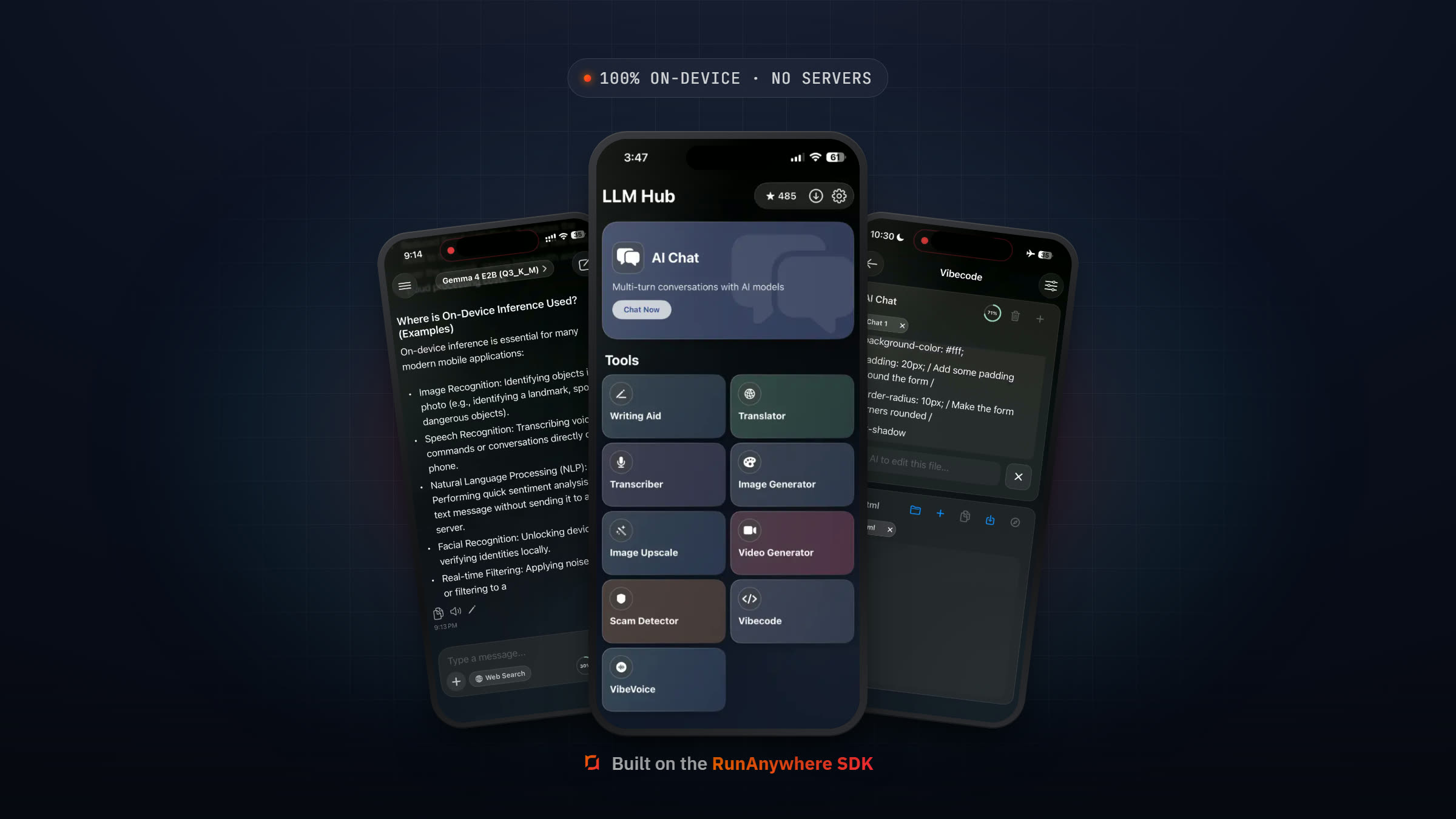
LLM Hub on iPhone running Gemma 4 locally. Fully on-device, no network required
| The numbers | |
|---|---|
| 6.5 weeks | from empty ios/ folder to App Store |
| $2K MRR | revenue before the iOS port |
| 1 | developer, first Swift project |
| 16+ | SDK patches upstreamed back to RunAnywhere |
Why This Was Supposed to Be Hard
Building an iOS LLM app from scratch means: compile llama.cpp with Metal, wire up embeddings, build a model registry and downloader, write a streaming pipeline that never locks the main thread, handle mmproj vision projectors, and get five or more chat-template families right, all in a language he had never written. That is months of plumbing before the first feature.
What RunAnywhere Collapsed It Into
The whole runtime boots in a handful of lines, straight from LLMHubApp.swift:
1try RunAnywhere.initialize(environment: .development)2LlamaCPP.register(priority: 100)3MainActor.assumeIsolated { ONNX.register() }45registerRunAnywhereModelCatalog()6Task {7 await RunAnywhere.flushPendingRegistrations()8 _ = await RunAnywhere.discoverDownloadedModels()9}
That turns on a unified, streaming, multimodal runtime: llama.cpp with Metal for GGUF and ONNX Runtime for embeddings, both shipped as prebuilt, signed XCFrameworks. Generation is one call:
1let stream = try await RunAnywhere.generateStream(prompt, options: options)2for try await token in stream.stream { appendTokenToUI(token) }
Vision is one call:
1let (stream, _) = try await RunAnywhere.processImageStream(2 image: VLMImage(image: uiImage),3 prompt: "Describe this.",4 maxTokens: 2565)
The SDK also covers the unglamorous parts: a model registry with multi-file support (a GGUF and its vision projector registered together via registerMultiFileModel), downloaded-model discovery, per-model context lengths, reasoning-token extraction, and per-stream metrics like tokens per second surfaced straight from the engine.
One SDK, Six Tools
Every text-generation feature in the app routes through a single facade built on RunAnywhere:
| Tool | What it does |
|---|---|
| AI Chat | Multi-turn, multimodal (text, image, PDF), sliding-window context management, streaming through generateStream |
| Vibecode | An on-device IDE. The model streams patched files back, the app writes them to disk and previews HTML live in Safari |
| VibeVoice | Hands-free voice loop: listen, generate, speak, repeat. LLM turns stream through RunAnywhere |
| Translator | 50+ languages, including photo translation through the RunAnywhere vision path |
| Scam Detector | Paste a suspicious message; the app pulls any URLs in it and analyzes everything locally. Screenshots go through processImageStream |
| Writing Aid | Summarize, rewrite, fix grammar, generate code. Same facade, same streaming call |
Plus document RAG and persistent memory: the app calls RunAnywhere's C core directly (rac_embeddings_create, rac_embeddings_embed) to run EmbeddingGemma 300M through the ONNX backend. Hybrid semantic and lexical retrieval, per-chat document pools, a global memory store, all offline. Your PDF never touches a network.
And one detail we did not expect: LLM Hub consumes Apple Foundation Models through RunAnywhere too. On iOS 26+ the app maps Apple's system model to the SDK's foundation-models-default id, so Apple Intelligence sits behind the same generate() call as every GGUF model, thinking-content extraction included.
Vibecode: The Feature That Stopped Us
VibeCoderScreen is an IDE, not a chat. The user picks a workspace folder (persisted with a security-scoped bookmark), describes what they want, and the model streams patched files back through RunAnywhere.generateStream. The app extracts the fenced code block and writes it to disk. For HTML, a loopback HTTP server built on raw BSD sockets (deliberately avoiding Apple's Network framework so it never triggers the local-network permission prompt) serves the result on 127.0.0.1 and opens Safari.
Vibecode: describe what you want, code streams in, live preview opens, all offline
A live context gauge estimates token usage against the loaded model's real context window, and when it fills, the app rolls into a fresh session on its own. You can vibe-code a working page on a plane.
A Power User's Integration
The most credible part of this story is how deep the integration goes:
- Hand-rolled chat templates for five model families (Gemma, Gemma 4, Llama, Mistral, gpt-oss Harmony), passed through the SDK's raw-prompt mode so the app controls formatting token-for-token
- Two-phase Harmony generation for gpt-oss-20B: stream the analysis channel to completion, then re-prompt for the final answer, giving a clean thinking/answer split in the UI
- Sliding-window context builder that budgets chat history against the actual loaded context window, reserving a quarter for the response
- Mid-stream stripping of Gemma 4 thinking tokens, plus model-residency management so an LLM and a VLM never occupy memory at once
And because the SDK is open source, he could go further than the public API. Between April and June, Timmy tagged 16+ custom builds of the RunAnywhere iOS SDK in his own repo (ios-sdk-v0.19.7-patched-v2 through v16): llama.cpp version bumps, a chunked-decode KV-cache fix, context-size forwarding, Metal batch-size tuning to stop out-of-memory crashes on 7B and 8B models, Gemma 4 prompt-format fixes. We took the changes back upstream. That is the loop we want with every developer.
The Model Catalog This Unlocks
LLM Hub's iOS catalog, a 3,500-line ModelData.swift, registers everything through the RunAnywhere model registry. All streaming, all offline:
| Model | Notes |
|---|---|
| Gemma 4 | E2B / E4B / 12B up to the 31B MoE, with mmproj vision projectors |
| Llama 3.2 1B / 3B | 17 quants each, 128K context |
| OpenAI gpt-oss-20B | Harmony format with thinking-token support |
| IBM Granite 4.x | Up to 512K context |
| LFM-2.5 / Ministral-3 / Phi-4 Mini | Including vision variants |
| EmbeddingGemma 300M | ONNX backend, powers RAG and memory |
| Apple Foundation Models | iOS 26+, bridged through the same SDK |
| Custom GGUFs | User imports migrate into the SDK-managed folder so loadModel(id) just works |
Six and a Half Weeks, Start to Finish
From the first commit to an empty ios/ folder on March 7 to the App Store on April 21: six and a half weeks, solo, in a language he had never written before.
If a solo developer can ship a $2K MRR local-AI app to the App Store in six weeks on RunAnywhere SDK, "is on-device AI ready for production?" stops being a real question.
Building Something Local-First?
Prebuilt llama.cpp with Metal, ONNX embeddings, model registry, streaming, vision. One SDK, one init call.
LLM Hub links:
If you've shipped something with RunAnywhere SDK, get in touch. We'd love to write the next one of these about you.